

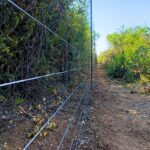

“How much does an electric fence cost?” is the question behind almost every enquiry we get, and it’s also the question most websites answer badly — either with a single vague number that doesn’t apply to most properties, or with no number at all, forcing you to fill out a form just to get a ballpark. This page exists to fix that: real, current pricing across every fence type we install, what actually moves the number up or down, and how to get an exact figure for your specific property in under two minutes.
Quick Answer: Price Per Linear Metre by Fence Type
| Fence Type | Cost per Metre (Installed) | Best For |
|---|---|---|
| Razor wire (standard galvanised) | KSh 500 – 900 | Budget-conscious physical deterrent |
| Razor wire (PVC-coated, coastal-grade) | KSh 650 – 1,200 | Coastal properties, salt-air resistance |
| Wall-top electric fence | KSh 800 – 1,200 | Existing walled residential/commercial compounds |
| Solar-powered farm/wildlife fence | KSh 450 – 1,800+ | Livestock containment, off-grid farms |
| Clear view / 358 mesh (galvanised) | KSh 8,500 – 9,500 | Schools, offices, open-boundary properties |
| Clear view / 358 mesh (powder-coated) | KSh 10,500 – 14,500 | Residential estates, hotels, premium finish |
| Clear view (electric-topped combination) | KSh 11,500 – 15,500 | Maximum-security clear-view properties |
These figures reflect current supply-and-installation rates for standard projects. Your exact cost depends on the factors below — treat this table as a planning reference, and use our free instant quote calculator for a number specific to your property.
Want a real quote today rather than a range? Call or WhatsApp us on +254 740 800099 with your approximate perimeter length — we can often give a ballpark on the call itself.
What Actually Changes Your Final Cost
Total perimeter length is the biggest factor, and it doesn’t scale in a straight line — longer runs typically achieve a better effective rate per metre, since fixed costs (energizer, transport, labour setup) get spread across more metres of fence.
Ground conditions matter more than most people expect. Rocky, compacted, or steeply sloped ground takes longer to dig post holes into, and steep gradients often require custom panel or post cuts fabricated before installation — both add cost and time, particularly for free-standing and clear view systems.
Existing infrastructure changes which fence type even makes sense. A property with a solid, adequately high wall already in place is the cheapest starting point — a wall-top fence adds strands to what’s already built. A property with no wall needs a free-standing or clear view system built from the ground up, which naturally costs more per metre since it includes the full post-and-panel structure rather than just the wire and energizer.
Finish and coating — galvanised versus powder-coated versus PVC-coated — is a meaningful swing factor, particularly for clear view fencing and razor wire. Coastal properties should budget for the PVC-coated premium (roughly 20–35% above standard galvanised); it isn’t optional if you want the fence to last.
Gates and access points typically add cost on top of the per-metre rate, since sliding or swing gates need individual fabrication to match the fence line and often require additional automation components.
Energizer sizing affects cost directly for solar and farm fencing in particular — a longer run, more strands, or wildlife-deterrent specification all require a higher-output energizer, which is priced separately from the wire and posts. See our energizer buying guide for how sizing affects price.
Cost by Property Type: Realistic Examples
A standard 50×100ft residential plot (roughly 92 metres of perimeter) with an existing wall typically costs KSh 85,000–135,000 for a wall-top electric fence, or from around KSh 46,000 for standalone razor wire as a budget-first layer.
A larger property without a wall (Karen or Runda-style plot, 200–400 metres) opting for clear view fencing typically runs into several hundred thousand shillings and upward in the powder-coated finish, or considerably less in standard galvanised — a wide range that reflects how much perimeter length varies at this property scale, which is exactly why a site visit matters more here than for a standard townhouse plot.
A small dairy farm (1–2km perimeter) with a solar-powered energizer typically falls in a broad range depending on strand count and terrain, though smaller sections or single-strand grazing setups cost considerably less — see our solar farm fencing guide for a fuller breakdown.
A school or institutional perimeter (500m–2km) choosing clear view fencing for its combination of security and visibility typically represents a significant investment depending on length and finish — institutional projects at this scale generally benefit most from a detailed, itemised quotation covering phased installation if budget requires it.
Why We Don’t Publish One Single “Average Price”
Any electric fence company giving you a single flat number before seeing your property is guessing, and guesses tend to be wrong in the direction that benefits the installer, not you — either an unrealistically low figure that grows once work starts, or a padded one that overcharges a straightforward job. Our pricing structure is transparent and itemised specifically so you can see what you’re paying for: materials, labour, and any site-specific factors, broken out rather than bundled into a single suspicious round number.
Financing and Phased Installation
Not every project needs to happen in one phase. For larger perimeters or tighter budgets, we regularly plan installations in stages — starting with the highest-priority section of a boundary, or beginning with a lower-cost layer like razor wire and upgrading to a full electric system later. If cost is the main barrier to getting started, it’s worth raising directly during your site visit rather than assuming the full project has to happen at once.
How to Get an Exact Number
The fastest route to an accurate figure is our free instant quote calculator, which gives an indicative estimate in under two minutes based on your fence type and approximate perimeter. For a final, binding number, a free in-person site assessment confirms ground conditions, exact measurements, and any gate or access requirements, followed by a written, itemised quotation — typically within 24 hours of the visit.
Frequently Asked Questions
Is the cheapest quote always the worst option? Not necessarily, but it’s worth checking what’s actually included — wire gauge, post specification, energizer brand, and warranty terms can all be quietly downgraded to hit a lower number. Compare like for like, not just the bottom line.
Does the price include the energizer? For wall-top and most standard packages, yes — always confirm this explicitly in any quotation, since some suppliers price the energizer separately.
Can I reduce cost by supplying some materials myself? In some cases, yes, though this can affect warranty coverage on the installation. Worth discussing directly if you’re trying to manage budget closely.
How accurate is the online quote calculator compared to a final quote? It’s a strong indicative estimate based on the details you provide, but ground conditions and exact measurements from a site visit can shift the final number — treat it as a planning tool, not a binding quote.
Get Your Exact Price
Instant online quote: electricfences.africa/electric-fencing-calculator-free Phone / WhatsApp: +254 740 800099 Email: info@electricfences.africa Get in touch directly: Contact Us page
Every quote is itemised, and there’s no obligation to proceed until you’re ready.