

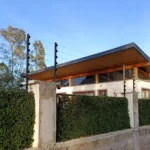

There’s a particular kind of exhaustion that comes from farming next to a wildlife corridor. You plant for months, watch the rains cooperate for once, and then one night an elephant herd walks through and the season is gone. Multiply that by thousands of smallholder families across Laikipia, Narok, Taita Taveta and the Tsavo borderlands, and you start to understand why farm electric fencing has become one of the most consequential pieces of infrastructure in rural Kenya — not just for farmers, but for the wildlife on the other side of the wire too.
At Electric Fences Africa, we install farm electric fencing for smallholders, ranches and conservancies across the country, and we’ve watched this shift happen firsthand: fencing has gone from a nice-to-have to genuinely essential infrastructure for both agricultural livelihoods and conservation outcomes.
What a Farm Electric Fence Actually Does
A farm electric fence works on a simple principle — a controlled, non-lethal pulse of electricity runs through the wire, delivering a short, sharp shock to anything that touches it. That’s enough to teach livestock and wildlife alike to keep their distance, without causing lasting harm. Systems range from single-strand portable poliwire for rotational grazing, right up to heavy multi-strand perimeter fences engineered specifically to hold back elephants along conservancy boundaries.
For most Kenyan farms, a fence needs to do at least one of two jobs: keep livestock contained inside a paddock, or keep predators, crop-raiding wildlife and stray animals out. Increasingly, farmers in wildlife-adjacent areas need both — a fence that holds their own cattle in a kraal at night, while also standing between their maize and the elephants that would otherwise flatten it before harvest.
Have a specific farm layout in mind? Call or WhatsApp our team on +254 740 800099 and we’ll talk through what fence type and energizer output actually fits your acreage and animal pressure.
Livestock Containment and Rotational Grazing
For dairy and beef farmers, the day-to-day value of an electric fence is straightforward — reliable containment without the cost of a masonry wall or the labour of constant herding. Portable poliwire systems have become particularly popular for strip grazing, where farmers move a single fence line daily to give cattle fresh grass without letting them wander into neighbouring plots or road reserves. It’s a low-cost way to get more grazing efficiency out of the same land, and it means fewer nights spent chasing stock that broke out overnight.
If your farm needs this kind of flexible, movable setup, our portable electric fence solutions for Kenyan farmers page covers the poliwire, poli-rope and post options we supply for exactly this use case.
Crop Protection: Keeping Wildlife Out Without Killing It
This is where farm electric fencing does some of its most important work. Elephants, baboons and antelope raiding crops overnight has historically pushed farmers toward retaliatory and often lethal responses — poisoning, snaring, or worse. A well-designed electric fence changes that equation entirely. It teaches animals, through a memorable but harmless shock, to simply avoid the area, which protects the harvest without escalating conflict with wildlife that in many cases is endangered or protected by law.
This matters more in Kenya than almost anywhere else, because so much of the country’s remaining elephant and large-mammal habitat sits directly against smallholder farmland. Getting that boundary right is quite literally the difference between coexistence and conflict.
Case Studies: What Electric Fencing Has Actually Achieved in Kenya
The numbers behind well-maintained farm and conservancy fencing in Kenya are hard to argue with.
Tsavo — an 88.6% drop in elephant incursions. Along the border of Tsavo West National Park, a USAID and IFAW-backed project delivered by Tsavo Trust erected a 33-kilometre solar-powered elephant exclusion fence between the Mtito Andei River and Kamunyu village. Before the fence, game scouts recorded nearly 1,700 elephant drives out of community land in a single year; two years after the fence went up, that number had fallen to under 200 — close to a 90% reduction in human-elephant conflict, benefiting roughly 7,000 small-scale farming families in the area.
Mount Kenya — a 450km fence and a 60%+ drop in conflict. The Mount Kenya Electric Fence Project, championed by Rhino Ark, has installed roughly 450 kilometres of solar-powered electric fencing around the forest boundary, including a dedicated 14-kilometre corridor connecting Mount Kenya to the Aberdares so elephants can migrate seasonally without passing through farmland. Since the programme scaled up in 2015, human-elephant conflict incidents in the area have dropped by more than 60%, alongside reduced illegal logging and encroachment into the forest.
Laikipia — 163km separating farms from migration routes. In Laikipia, home to Kenya’s second-largest elephant population outside the Mara, conservation group Space for Giants has led construction of a 163-kilometre electric fence creating a clear boundary between smallholder agriculture and elephant migration corridors — aimed at protecting both farmers’ livelihoods and the long-term safety of the elephant population moving through the region.
Amboseli — the fences that hold, and the ones that don’t. Academic research comparing two fence lines near Amboseli National Park (Namelok and Kimana) found that a well-maintained, properly earthed fence significantly reduced crop-raiding, while a neighbouring fence bordering a wildlife sanctuary was breached repeatedly — a useful reminder that a fence is only as effective as its voltage, earthing and maintenance regime. It’s a finding we take seriously in our own installations: an under-maintained fence gives farmers false confidence, which is often worse than no fence at all.
Taken together, these projects point to the same conclusion: electric fencing, done properly, is one of the most effective non-lethal tools available for reducing human-wildlife conflict at scale — which is also why conservation organisations, county governments and community conservancies across Kenya have invested so heavily in it over the past decade.
It’s worth being honest, too, that fencing isn’t without debate in conservation circles — researchers have raised valid questions about long-term habitat fragmentation as more land gets fenced. That’s part of why proper planning, corridor design and community involvement matter as much as the fence itself, and it’s a conversation worth having with a conservancy or county wildlife office before any large-scale project begins.
Protecting Endangered Species — Not Just Excluding Them
It’s easy to think of a farm fence purely as a barrier keeping animals away from people, but the conservation value runs both directions. Well-planned fencing reduces retaliatory killing of elephants and predators by frustrated farmers, keeps wildlife away from roads and settlements where they’re at greater risk, and — when corridors are built in, as at Mount Kenya — actively supports the safe seasonal movement that many endangered species depend on. For predators in particular, boma and kraal electrification has proven effective at protecting livestock at night without lethal retaliation against lions, hyenas or leopards, which is a significant conservation win in areas bordering reserves and conservancies.
What to Consider Before Fencing Your Farm
Not every farm needs the same system. A dairy paddock and a maize field on the edge of a wildlife corridor call for very different voltage, strand count and energizer output. A few of the questions we ask on every site visit: What’s actually threatening the crop or livestock — stray domestic animals, or wildlife like elephants and buffalo that need a much stronger deterrent? Is the site on or near the grid, or does it need a solar powered energizer to run reliably off-grid? And how long is the perimeter, since that determines both energizer sizing and total project cost.
We provide a free site assessment before any quotation, because getting these details right upfront is what determines whether a fence actually works.
Get a Farm Fencing Quote
Whether you’re containing dairy cattle on a two-acre smallholding or fencing a conservancy boundary against elephants, our team has installed farm electric fencing across all 47 counties since 2009. Reach out and we’ll come back with a written, itemised quote — no pressure, no obligation.
Phone / WhatsApp: +254 740 800099 Email: info@electricfences.africa Instant online quote: electricfences.africa/electric-fencing-calculator-free Solar farm fencing details: electricfences.africa/solar-powered-farm-electric-fences Portable fencing for grazing: electricfences.africa/portable-electric-fence-solutions-for-kenyan-farmers Get in touch directly: Contact Us page
A fence protecting a farm is, more often than not, protecting a piece of Kenya’s wildlife too. We’d be glad to help you build one that does both.