

Ask five homeowners in Nairobi what they did about security this year, and you’ll probably get five different answers — one added an electric fence, one topped their wall with razor wire, one did both, and one built a standalone fence around a plot that never had a wall to begin with. There isn’t a single “correct” answer, because the right security fence depends on what you’re actually protecting, what your boundary already looks like, and what you’re willing to spend.
We install all three of the options below across Kenya every week, so this guide walks through what each one actually does, what it costs in 2026, and — more usefully — which one tends to fit which kind of property.
The Three Main Home Security Fencing Options in Kenya
Broadly, homeowners choose between three approaches, or some combination of them: a wall-top electric fence added to an existing perimeter wall, razor wire installed on top of a wall or as its own standalone barrier, and a free-standing electric fence built from the ground up where no wall exists at all. Each solves a slightly different problem, and understanding the difference is really the whole decision.
Want a straight answer for your specific property? Call or WhatsApp our team on +254 740 800099 — tell us your perimeter length and wall type, and we’ll tell you honestly which option makes sense before we quote anything.
Wall-Top Electric Fences: The Most Common Choice in Kenyan Estates
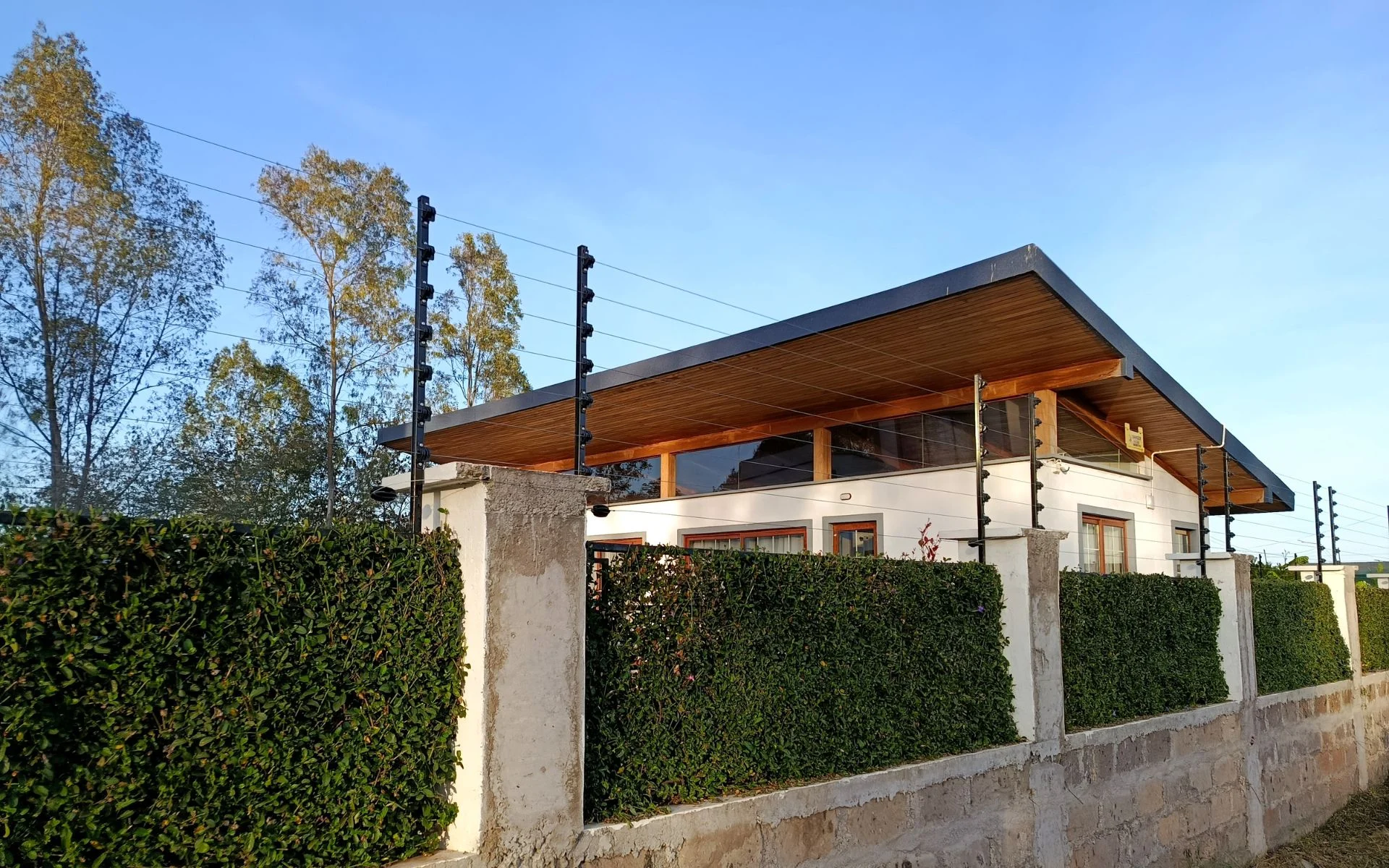
If you’ve walked through Karen, Runda, Lavington or Kitengela recently, the thin strands of wire running along the top of nearly every compound wall are wall-top electric fences — and there’s a reason they’ve become close to standard in Kenyan residential security. A wall-top system adds 8 to 10 live wire strands directly onto your existing wall, carrying pulses of roughly 5,000–8,000 volts every 1.2 seconds. Touch it, and you get a sharp, memorable, non-lethal shock that stops most climbing attempts before they start.
Because it uses a wall you’ve already built, there’s no excavation and no new posts — which keeps both the cost and the installation time down. A standard 50×100ft plot (roughly 92 metres of perimeter) typically runs KSh 800 to KSh 1,200 per metre installed, landing around KSh 85,000 to KSh 135,000 for the full job depending on the package tier and whether razor wire is added on top. Most residential installations are complete in a single day.
The real advantage over other options is the active deterrent — a wall can be climbed, and razor wire can (with effort and the wrong pair of gloves) be bridged, but a live wire genuinely changes an intruder’s calculation in the moment. Pair that with battery backup for load-shedding nights and GSM alerts that text your phone the instant the fence is touched, and it’s easy to see why it’s the most requested residential security upgrade we install.
Full pricing tiers, package breakdowns and an instant cost estimator are on our Wall-Top Security Electric Fences page.
Razor Wire: The Fastest, Most Affordable Physical Barrier
Razor wire — sometimes called concertina wire or barbed tape — takes a different approach entirely. Instead of an active shock, it’s a passive but genuinely formidable physical barrier: sharp, high-tensile steel blades stamped at roughly 33mm intervals along a galvanised wire core, designed to grip and lacerate rather than merely puncture. There’s no electricity involved, which means zero running cost and no maintenance beyond an occasional rust check.
In Kenya, razor wire comes in a few practical formats. Concertina coils (450mm for residential, up to 980mm for industrial or government-grade security) expand into a dense, three-dimensional barrier. Flat wrap panels lie close to the wall for a neater, less aggressive look — popular in upmarket estates where homeowners want the deterrent without the visual bulk. And green PVC-coated wire, which costs roughly 20–35% more than plain galvanised, is the recommended choice for coastal properties in Mombasa, Kilifi and Malindi, where salt air can start corroding untreated wire within a few years.
Cost is where razor wire wins outright. Standard 450mm concertina runs KSh 500 to KSh 900 per metre fully installed, with flat wrap starting even lower. For a budget-conscious upgrade, or as the outer layer on a property that already has other security measures, it’s genuinely hard to beat on a cost-per-metre basis.
The trade-off is that it’s a passive deterrent — highly effective at slowing and discouraging an intruder, but without the immediate active response of a shock or an alarm notification. That’s precisely why so many of our clients combine it with an electric fence rather than choosing one or the other; more on that below. Full specifications, coil sizes and current pricing are on our Razor Wire Fence page.
Free-Standing Electric Fences: For Properties Without a Wall
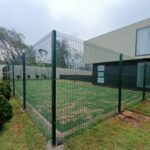
Not every property has a wall to build on — new plots, open-plan compounds, larger rural homes, or estates designed around visibility rather than masonry. For these, a free-standing electric fence is built entirely from the ground up: steel posts driven into the ground, multiple strands of high-tensile wire run between them, and an energizer powering the whole system independently of any existing structure.
This is also the natural choice where you want a taller or more flexible perimeter than a standard wall allows, or where the property is large enough that building a masonry wall around the whole boundary would be prohibitively expensive. Free-standing systems scale well — the same basic approach works for a modest suburban plot or a multi-acre rural home, and can be built with anywhere from three to a dozen strands depending on the level of security required.
Need a free-standing system rather than a wall-top upgrade? Our team can walk you through post spacing, strand count and energizer sizing for your specific plot — reach us at info@electricfences.africa or +254 740 800099. You can also browse our full range of electric fencing solutions for ground-up and farm-style installations.
Combining Systems: Why So Many Homeowners Choose Both
In practice, the highest-security residential installations we do rarely use just one of these three. The most common combination is a wall-top electric fence with a razor wire coil mounted on the same bracket system — you get the physical, gripping barrier of the razor wire and the active shock-and-alarm response of the electric fence on the same wall, for a relatively modest cost increase over the electric fence alone. It’s popular enough that we sell it as a dedicated package — see our Top Wall Electric Fence with Razor Wire installation for a typical 50×100ft plot.
If budget allows, adding CCTV surveillance at entry points rounds the system out further — the fence deters and delays, the camera identifies and records, and the alarm notifies you the moment something happens.
Wall-Top vs Razor Wire vs Free-Standing: A Quick Comparison
| Factor | Wall-Top Electric | Razor Wire | Free-Standing Electric |
|---|---|---|---|
| Needs existing wall | Yes | No (works with or without) | No |
| Active deterrent (shock/alarm) | Yes | No — physical only | Yes |
| Typical cost per metre installed | KSh 800 – 1,200 | KSh 500 – 2,500 | KSh 1,500 – 4,000+ |
| Running cost | Low (electricity/battery) | None | Low (electricity/solar) |
| Installation time (standard plot) | 1 day | 1–2 days | 2–5 days |
| Best for | Existing walled compounds | Budget upgrades, any boundary type | Open plots, large or rural properties |
Which One Should You Choose?
If you already have a boundary wall and want the strongest active deterrent for the money, a wall-top electric fence is almost always the right starting point. If budget is the primary constraint, or you want a fast physical upgrade with zero ongoing cost, razor wire — on its own or as an addition to an electric fence — does the job well. And if your property doesn’t have a wall at all, or you’re securing a larger rural or semi-open plot, a free-standing electric fence is generally the only practical option that gives you real perimeter control.
None of this needs to be guesswork on your end. A free site assessment lets our technicians look at your actual wall, plot size and risk profile before recommending anything — which is a very different conversation from a generic online price list.
Getting Started
Every project we take on — whether it’s a single wall-top fence for a Kitengela townhouse or a combined electric-and-razor-wire system for a Karen compound — starts with a free consultation and site visit, followed by a written, itemised quote within 24 hours. Homeowners across Nairobi have told us the difference was noticeable almost immediately — fewer break-in attempts, and simply feeling more at ease at night, particularly after previous incidents.
Phone / WhatsApp: +254 740 800099 Email: info@electricfences.africa Instant online quote: electricfences.africa/electric-fencing-calculator-free Wall-top electric fence details: electricfences.africa/top-wall-security-electric-fences-in-kenya Razor wire fence details: electricfences.africa/razor-wire-fences-solutions-in-kenya Free-standing & farm fencing solutions: electricfences.africa/product-category/fencing_solutions Get in touch directly: Contact Us page
We’ve secured homes across all 47 counties since 2009. Get in touch with your property details and we’ll come back with an honest recommendation and a written quote — no pressure, no obligation.