


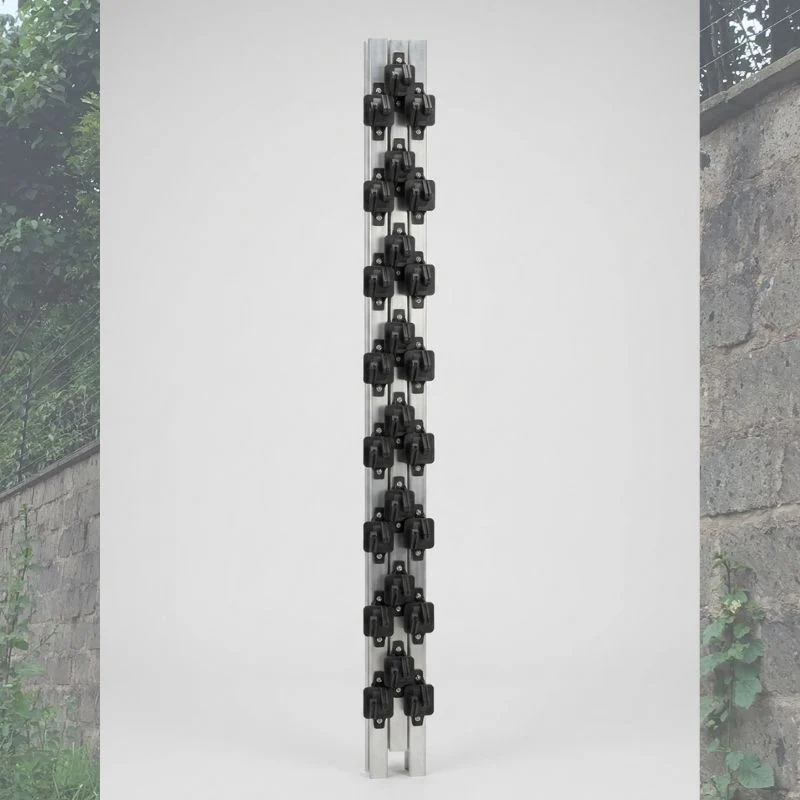
Every electric fence conversation tends to focus on the energizer and the wire — understandably, since that’s where the shock comes from. But the posts holding the whole system upright and under tension are just as decisive for how long a fence actually lasts, and galvanized steel has become the standard choice across Kenyan farm, wildlife and security fencing for reasons that go well beyond simply being “stronger than wood.” Here’s the full picture.
What Makes a Post “Galvanized Steel”
Galvanizing is the process of coating steel with a protective layer of zinc, either through hot-dip galvanizing (the steel is fully submerged in molten zinc) or other zinc-coating methods, creating a barrier that stops moisture and oxygen reaching the steel underneath — the actual mechanism that prevents rust. A properly galvanized post isn’t just painted or coated cosmetically; the zinc layer is metallurgically bonded to the steel, which is why quality galvanized posts continue resisting corrosion even after the surface gets scratched or scuffed during installation, unlike a simple paint coating that fails the moment it’s breached.
Not sure which post type suits your project? Call or WhatsApp us on +254 740 800099 and we’ll recommend the right specification for your fence type and terrain.
Why Galvanized Steel Outperforms Wood and Plastic
Durability is the headline advantage — properly galvanized steel posts last 20 to 30 years in Kenyan conditions, resisting the sun exposure, seasonal rain, and humidity swings that steadily degrade untreated materials. Strength matters directly for fence performance, since steel posts hold tension far better than wood under the sustained pull of high-tensile wire strung across long runs, and they withstand significant pressure from livestock or wildlife testing the fence line without snapping or leaning the way a weaker post might. Flexibility in fabrication — steel posts can be welded, cut and customised to fit unusual terrain, corners, gate openings and gradient changes in ways that standardised wooden posts often can’t match. And low maintenance rounds out the case: unlike wooden posts, galvanized steel doesn’t rot, doesn’t need periodic chemical re-treatment, and isn’t vulnerable to termite damage — a genuine, recurring cost and reliability issue for wooden posts in many parts of Kenya.
Wooden posts still have a place — they’re commonly used in rural and agricultural settings, and treated wooden posts specifically hold up well as a lower-cost, termite-resistant option for general agricultural fencing. Some larger wildlife-deterrent fences, particularly those built to withstand elephants and buffalo, sometimes use treated wooden posts deliberately, since a degree of give under massive animal pressure can be preferable to a rigid post that snaps outright. But for most security, residential and standard farm fencing applications, galvanized steel is the stronger, longer-lasting, lower-maintenance choice.
Types of Galvanized Steel Posts We Supply
Line posts (W-posts) form the backbone of a fence run, holding wires firmly in place and maintaining consistent spacing and tension along straight sections — these are the workhorse posts you’ll see repeated every few metres along any properly built fence line, whether for top wall electric fences or free-standing runs.
Corner and strainer posts are heavier-duty than standard line posts, engineered to handle the concentrated tension where a fence changes direction or terminates — typically set in concrete for extra stability, since these posts absorb significantly more load than a straight-line post between two neighbours.
Gate posts are reinforced further still, since they need to support not just wire tension but the weight and repeated stress of a gate opening and closing.
Typical Specifications
For standard free-standing electric fencing, galvanized steel posts are commonly supplied in 2.4 metre lengths, giving an above-ground fence height suited to both livestock containment and security deterrence once set into the ground. Post spacing typically runs every 8 to 10 metres along straight runs, closer for uneven terrain or higher-tension wire configurations, with corner and gate posts spaced according to the specific layout rather than the standard interval. For clear view and mesh-panel fencing specifically, posts commonly run 60mm x 80mm tube profile with a 200mm x 200mm base plate, giving the rigidity needed to support welded mesh panels rather than just wire strands.
Real Results: A 10km Steel-Post Fence in Narok
A group of wheat farmers in Narok — one of Kenya’s leading wheat-producing regions, and an area facing regular pressure from both wildlife and human trespassers — installed a 10-kilometre free-standing electric fence using galvanized steel posts to protect their fields. The design used a six-wire system on 2.4-metre galvanized steel posts spaced every 10 metres, powered by a solar energizer suited to the fence’s length and remote location. The result was a significant reduction in crop losses during the following harvest season compared to the unfenced years before, with the farmers reporting a dramatic improvement in both yield protection and peace of mind. It’s a genuinely representative example of what a properly specified steel-post fence delivers at scale — not just security in the abstract, but a measurable protection of real agricultural income.
Coastal and High-Corrosion Considerations
Standard galvanized posts perform well across most of Kenya, but salt-air environments along the coast accelerate zinc coating degradation faster than inland conditions. For Mombasa, Kilifi, Malindi and the wider coastal strip, we recommend a heavier galvanizing specification or PVC-coated posts for genuinely long-term corrosion resistance — the same principle that applies to coastal-grade clear view and razor wire fencing applies equally to the posts holding any fence type up.
What Galvanized Steel Posts Cost in Kenya
Post pricing varies by gauge, length and profile, generally forming part of an overall per-metre fence installation cost rather than being priced as a standalone line item for most residential projects — our instant quote calculator covers current per-metre installed pricing across fence types, which includes posts, wire, insulators and energizer as a complete package. For farm and free-standing fencing specifically, where post specification has a larger impact on total project cost given the quantities involved, a site assessment gives the most accurate figure based on your fence’s total length, terrain, and required post spacing.
Installation Best Practices
Getting genuine longevity from galvanized steel posts depends as much on installation as on the posts themselves. Posts should be set to an adequate depth — typically at least 600mm below ground for standard line posts, deeper for corner and gate posts under higher load — and corner or strainer posts are best set in concrete rather than simply driven into soil, given the concentrated tension they need to resist. Spacing should account for terrain: tighter spacing on undulating ground keeps wire tension consistent, while standard 8–10 metre spacing works well on flat, even runs.
Frequently Asked Questions
How long do galvanized steel electric fence posts actually last in Kenya? Properly galvanized posts typically last 20–30 years under normal conditions, with coastal or highly corrosive environments benefiting from heavier galvanizing or PVC coating to reach the same lifespan.
Are galvanized steel posts better than wooden posts for wildlife fencing? For most wildlife-deterrent applications, yes — steel withstands sustained animal pressure better. Some fences targeting the largest animals (elephants, buffalo) sometimes use treated wooden posts deliberately for their give under extreme force, but this is a specific design choice rather than a general rule.
What spacing is standard for galvanized steel fence posts? Typically every 8–10 metres for line posts on straight, flat runs, with closer spacing on uneven terrain and reinforced corner and gate posts spaced according to the specific layout.
Do galvanized posts need any maintenance over their lifespan? Minimal — periodic visual checks for any coating damage or leaning posts are worthwhile, but galvanized steel doesn’t require the regular chemical treatment wooden posts need to resist rot and termites.
Get the Right Posts for Your Fence
Phone / WhatsApp: +254 740 800099 Email: info@electricfences.africa Instant online quote: electricfences.africa/electric-fencing-calculator-free Full solutions catalogue: electricfences.africa/categories Get in touch directly: Contact Us page
Genuine galvanized steel posts, specified correctly for your terrain and fence type — installed by a team that’s built fences across all 47 counties since 2009.