


Why They’re Essential for Safety and Compliance
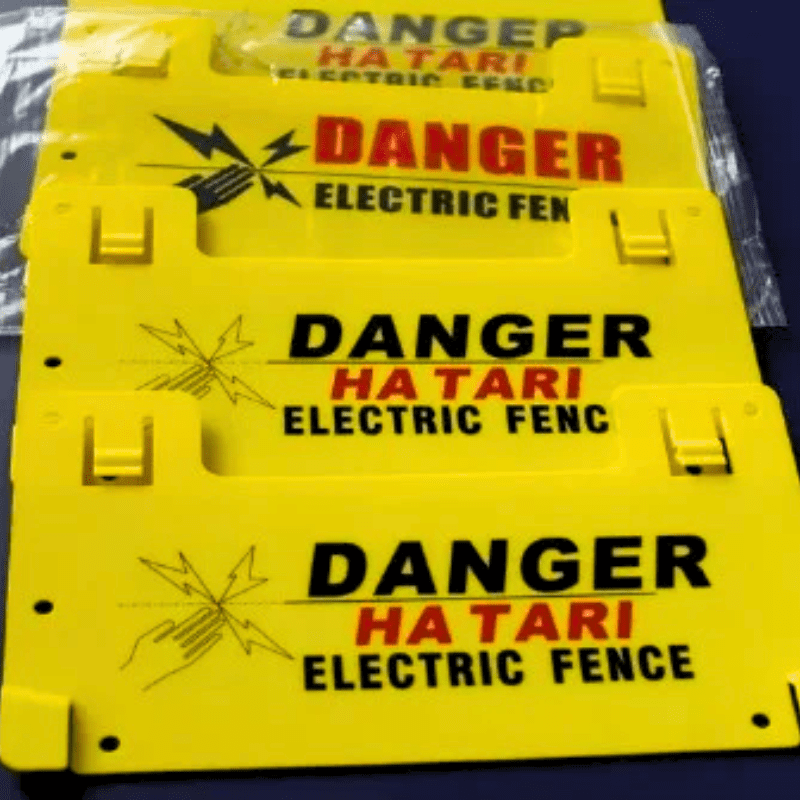
Electric fences have become a common sight across Kenya — protecting homes, farms, conservancies, and commercial properties. Whether installed around a gated estate in Nairobi or a wildlife barrier in Laikipia, one feature always stands out: the bright “HATARI – DANGER” warning signs.
But what exactly do these signs mean, why are they so important, and what are the legal requirements governing their use?
In this article, we explore the purpose, design, and standards of electric fence warning signs in Kenya — plus expert installation tips from Electric Fences Kenya Ltd.
1. The Purpose of “HATARI/DANGER” Warning Signs
The word “Hatari” means “Danger” in Swahili, and together with the English translation, it provides a clear warning to anyone near the fence that it carries high voltage.
These signs serve three critical purposes:
a) Safety Awareness
Electric fences deliver high-voltage pulses (typically 5,000–9,000 volts), which can cause painful shocks if touched.
The signs warn people — especially children, workers, and visitors — to keep away from the fence.
b) Legal Compliance
Kenyan safety regulations, and international standards such as IEC 60335-2-76, require all electric fences to display clear and visible warning signage.
This protects the property owner from liability in case of accidental contact.
c) Public Education
For community or shared boundaries, such as wildlife conservancies or residential estates, these signs alert anyone nearby that the fence is electrified, not just a standard barrier.
2. Design and Placement Standards
Electric fence warning signs in Kenya must follow specific visibility and placement guidelines for maximum safety.
Key Design Features
- Color: Bright yellow background with bold black text.
- Text: “HATARI” (Swahili) and “DANGER” (English) printed on both sides.
- Symbols: Universal lightning bolt ⚡ icon or “Electric Shock Hazard” symbol.
- Material: UV-stabilized plastic or weatherproof PVC to resist sun fading and rain damage.
- Size: Typically 200 mm x 100 mm for residential use, and up to 300 mm x 150 mm for high-security or wildlife fences.
Placement Rules
- Signs must be fixed at intervals not exceeding 30 meters along the fence line.
- Signs should be visible from both directions of approach.
- Place them near gateways, corners, and public access points.
- Mount signs on live wires only using special clips or ties to prevent short circuits.
3. Legal and Regulatory Compliance in Kenya
The Kenya Bureau of Standards (KEBS) and Energy and Petroleum Regulatory Authority (EPRA) require that electric fence systems comply with safety standards protecting human life and property.
According to KEBS KS EAS 102:2017 – Safety of Electric Fences and Barriers, property owners must ensure:
- All electrified boundaries display visible warning signage.
- Warning text is legible and bilingual (Swahili and English).
- Fences installed near public paths, roads, or neighboring properties are clearly marked.
Failure to include proper signage can result in:
- Penalties for non-compliance under safety regulations.
- Insurance claim denial in case of incidents.
- Civil liability for injuries caused by unmarked fences.
4. Types of Electric Fence Warning Signs in Kenya
At Electric Fences Kenya Ltd, we supply several types of “Hatari/Danger” warning signs depending on the environment:
| Type | Material | Typical Use |
|---|---|---|
| Standard PVC Sign | UV-resistant plastic | Residential or small farm fences |
| Heavy-Duty Polycarbonate | Weatherproof, long-lasting | Commercial and industrial fences |
| Reflective Warning Sign | Glows under headlights | Roadside and security fences |
| Wildlife Fence Sign | Large format (300x150mm) | Conservancies and national park borders |
Each sign is designed for maximum visibility and durability, ensuring long-term compliance and safety.
5. Installation Best Practices
To ensure proper visibility and safety compliance, here are our professional installation tips:
- Use proper insulators or clips when attaching signs — never nail or tie directly onto the live wire.
- Space signs evenly (every 10 meters) and more frequently in high-traffic areas.
- Check for fading or damage every 6 months and replace worn signs immediately.
- Ensure bilingual printing — always include both “HATARI” and “DANGER”.
- Include signage near gates and entry points, where people are most likely to approach.
6. Why Warning Signs Matter Beyond Compliance
Beyond meeting regulations, warning signs show responsibility and care for public safety.
In rural areas, they educate communities that electric fences are not lethal but serve as deterrents.
In urban environments like Nairobi and Mombasa, they protect property owners from legal risks and reinforce professionalism — especially for commercial electric fence installations in factories, schools, and estates.
7. Where to Buy Quality “Hatari/Danger” Signs in Kenya
Electric Fences Kenya Ltd supplies high-quality, UV-resistant electric fence warning signs made to KEBS standards.
We stock a full range of accessories including insulators, energizers, gate handles, and voltage testers.
Contact Us Today
Call/Text/WhatsApp: 0722 708034 / 0720 456534
Visit: www.electricfences.co.ke
Email: info@electricfences.co.ke
“Safety begins with awareness. A visible HATARI/DANGER sign could save a life.”
Conclusion
Electric fence warning signs are more than just compliance tools — they’re a symbol of safety, professionalism, and community responsibility.
By ensuring every electric fence in Kenya displays clear “HATARI/DANGER” signage, we protect lives, reduce liability, and uphold high installation standards.
At Electric Fences Kenya, we help property owners, farmers, and institutions install safe, compliant, and durable fencing systems across the country.